Reverse engineering my cloud-connected e-scooter and finding the master key to unlock all scooters
A few years ago, I decided to buy an electric scooter for commuting in the city. I had already been using rental scooters for a while, but got tired of having to "hunt" for one or realizing there isn't one near my apartment building when I wanted to go to work in the morning.
I decided to go with an Äike T. This wasn't because it was necessarily better than the competitors' products. In fact, the scooter was fairly expensive, and at that price point, there were certainly scooters on the market that were technically superior.
However, I went with the Äike because it was a local product and I like to support local companies whenever possible. Äike (meaning "lightning" in Estonian) was designed and manufactured in Estonia, right here in Tallinn. From what I could tell, they also didn't use many off-the-shelf components. The design was fully custom, the IoT module used in the scooter was also locally produced, they had their own battery pack, and so on. This isn't necessarily a good thing because it hurts the maintainability of the scooter, but I found their product ambitious.
Another reason was that they had a sister company Tuul (meaning "wind" in Estonian) which offered rental scooters. These scooters were also just Äike scooters, and out of all of the competitors, I enjoyed the ride that Tuul/Äike offered the most and used their rental service whenever possible.
Äike went bankrupt last year. While this is unfortunate as in the long term, it'll become increasingly harder to source replacement components due to all of them being custom, I started having much more immediate concerns regarding the usability of my scooter. The scooter does not have a manual start-stop function. Starting and stopping, unlocking the battery tray, setting it into transport mode, etc is all done via their app.
> read moreBypassing dnsmasq dhcp-script limitations for command execution in config injection attacks
When researching networking devices, I frequently encounter a particular vulnerability: the ability to inject arbitrary options into dnsmasq's config files. These devices often delegate functionality to dnsmasq, and when they allow users to set configuration options, they might perform basic templating to generate configuration files that are then fed to dnsmasq. If the device fails to properly encode user input, it may allow users to insert newline characters and inject arbitrary options into the config file.
> read moreRetrospective on hosting my blog inside an LTE modem, 4 years later
Exactly 4 years ago today, I wrote about hosting my blog on an LTE modem inside the PinePhone. To summarize, the Quectel LTE modem in the PinePhone is a fully functioning Linux system, and being fairly easy to root, I decided to host my blog on it and use USB networking to make it accessible to the world.
While a fun project, I had to abandon this experiment due to several issues, some more obvious than others.
> read moreWhen parameterization fails: SQL injection in Nim's db_postgres module using parameterized queries
I discovered a potential SQL injection vulnerability in Nim's standard library module db_postgres. This affects applications using this module with older PostgreSQL databases or configurations where standard_conforming_strings is disabled.
CVE-2022-34960 Symlinks as mount portals: Abusing container mount points on MikroTik's RouterOS to gain code execution
RouterOS release 7.4beta4 introduced containers for MikroTik devices. From the changelog:
container - added support for running Docker (TM) containers on ARM, ARM64 and x86
It turns out that due to a couple of implementation flaws, it's possible to execute code on the host device via the container functionality.
> read moreCVE-2022-26147 Code execution as root via AT commands on the Quectel RG500Q-EA 5G modem
I recently researched a relatively new 5G-capable modem from Quectel: the RG500Q-EA. I identified a security issue with how the OTA download procedure operates which allows an attacker to execute commands on the modem as root.
CVE-2022-23602 Don't trust comments
And habitually review the third party code you're using - even when it's in the standard library.
> read moreCVE-2021-31698 Code execution as root via AT commands on the Quectel EG25-G modem
As I mentioned towards the end of my previous blog post, where I detailed running my blog on the PinePhone's GSM/WWAN/GPS modem, I suspected that the daemon responsible for parsing AT commands on the modem's side is susceptible to OS command injection, as it uses a lot of system() calls. My hunch turned out to be true.
This blog is now hosted on a GPS/LTE modem
No, really. Despite the timing of this article, this is not an April Fool's joke.
> read moreViewing and resetting the BIOS passwords on the RedmiBook 16
I recently lost the BIOS password for my Xiaomi RedmiBook 16. Luckily, viewing and even resetting the password from inside a Linux session turned out to be incredibly easy.
> read morePatching ACPI tables to enable deep sleep on the RedmiBook 16
I recently purchased Xiaomi's RedmiBook 16. For the price, it's an excellent MacBook clone. Being a Ryzen-based laptop, Linux support works great out of the box, with one big caveat: deep sleep does not work. I decided to try and fix this.
> read moreiopshell: A shell-like application for communicating with IOPSYS devices
You might've noticed I've been using a custom application for demonstrating vulnerabilities I've discovered on IOPSYS (Inteno) devices for the last few posts. This application is iopshell, which aims to provide an easy way of communicating with the backend of these devices.
chroot shenanigans 2: Running a full desktop environment on an Amazon Kindle
In my previous post, I described running Arch on an OpenWRT router. Today, I'll be taking it a step further and running Arch and a full LXDE installation natively on an Amazon Kindle, which can be interacted with directly using the touch screen. This is possible thanks to the Kindle's operating system being Linux!
> read morechroot shenanigans: Running Arch Linux on OpenWRT (LEDE) routers
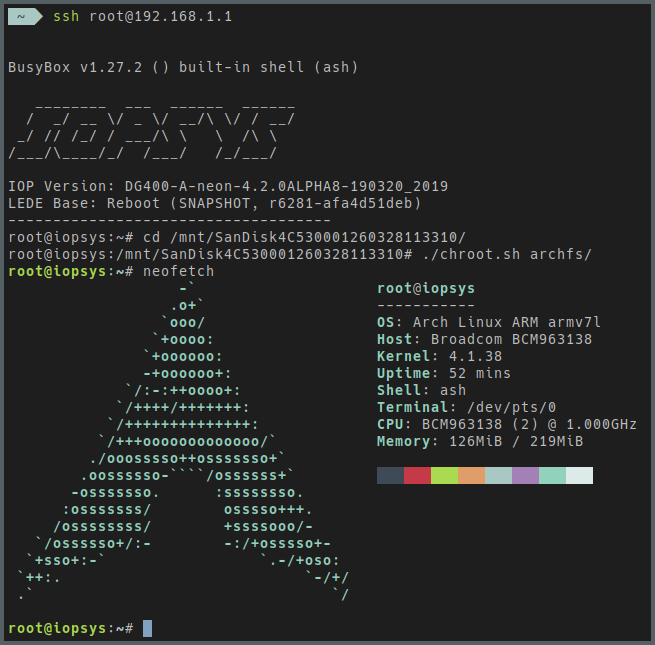
Here's some notes on how to get Arch Linux running on OpenWRT devices. I'm using an Inteno IOPSYS (OpenWRT-based) DG400 for this, which has a Broadcom BCM963138 SoC - reportedly ARMv7 but not really (I'll get to that later).
> read moreCVE-2018-20487 Unsafe firewall includes allowing for remote code execution on Inteno's IOPSYS devices
In Inteno's IOPSYS devices, and very possibly other devices running firewall3 (which is included by default on most OpenWRT-based firmwares), it is possible for an authenticated attacker to abuse firewall includes to remotely execute any binary or script as root. A proof-of-concept exploit can be found at the end of the post. This vulnerability has been assigned the CVE ID: CVE-2018-20487.
Creating a key generator to reset a Hikvision IP camera's admin password
Unfortunately, generic IP cameras are notorious for their poor security practices. Most of the time, the manufacturers don't force secure passwords, and more often than not you can sign in with default passwords. Some do, though - one of these manufacturers is Hikvision. Upon logging in for the first time with the password 12345, it forces you to change it. Is this enough to stop attackers from accessing the device? Turns out it isn't.
CVE-2018-14533 From writing to /tmp to a root shell on Inteno IOPSYS
In this blog post, I describe how multiple safe features and configurations can be used to gain full filesystem read-write access - and a root shell - on devices running Inteno's IOPSYS as an authenticated user. This issue has been assigned the CVE ID: CVE-2018-14533.
> read moreCVE-2018-10123 pwn910nd - abusing OpenWRT's printer server to become root
I have discovered yet another vulnerability in Inteno's IOPSYS firmware - but I believe this to affect all OpenWRT or LEDE based routers that ship with the printer server p910nd. Any authenticated user can modify the configuration for the printer server in a way which allows them to read and append to any file as root. This leads to information disclosure and remote code execution. This vulnerability has been assigned the CVE ID: CVE-2018-10123.
> read moreCVE-2017-17867 Remote Code Execution vulnerability in Inteno's Iopsys
I've discovered a remote code execution vulnerability in the latest version of Iopsys router software. This affects all Inteno routers and is caused by the dhcp daemon. This vulnerability has been assigned the ID CVE-2017-17867 and a CVSSv3 severity score of 8.8.
> read moreCVE-2017-11361 CVE-2017-11361 post-remedy: Is it fixed?
A couple of days ago I wrote about CVE-2017-11361, which described abusing misconfigured Access Control Lists to gain root access to Inteno routers. Inteno has recently deployed a quick-fix, removing access to the file:read and all router.dropbear calls. Does this stop people with malicious intent from accessing the router?
CVE-2017-11361 Inteno misconfigured ACLs leading to information disclosure and logging in as root
Recently, while testing the security of Inteno routers, I found a misconfiguration in the Access Control Lists, which allows any authenticated user to see the contents of any file, write their own files and add an SSH key to the router, allowing for easy log in as root. By default, the consumer is only provided with the user account and the built-in support and admin accounts are not accessible. This vulnerability is dangerous as by default, the password for user is the same as the pre-set Wi-Fi key, or in some cases user, allowing for easy authentication. This vulnerability has been assigned CVE ID: CVE-2017-11361 and a CVSSv3 score of 8.8.
> read moreInstalling custom OpenWRT on an Inteno (DG301) router
Soon after getting an Inteno DG301 router from my ISP Telia, I poked around the firmware trying to find out more about its internals. It became apparent that the iopsys firmware running on the machine was a customised version of OpenWRT. The modifications by Inteno include making it more fool-proof for consumers, removing any easy access to its internal settings in the process. It's not possible access SSH without proper keys, and Telnet is disabled, even in OpenWRT's failsafe mode. In addition to the provided user account, there are also the support and admin accounts, but the passwords for these are not known. I did manage to dump most of the filesystem by abusing an insecure default option in the router's bundled Samba and found a couple of other exploitable bugs, however, I still didn't have proper shell access or a way to invoke opkg to install my own packages.
> read moreksoft's Easy Auto Refresh extension is selling your data
I was doing some work with Burp Suite through Chrome (which I don't often do) and very soon I realised that all of my requests were being relayed to a domain edatasales.com. After probing around a bit, I narrowed it down to the Easy Auto Refresh plugin for Chrome, which currently has over half a million downloads. Disabling this plugin also stopped all requests to edatasales.com.
Restoring stock BIOS on a Braswell Chromebook with a broken rom
Since Braswell is still widely unsupported in the world of Chromebooks (no public Tianocore/Windows rom released yet), one can expect to run into many issues when developing for these Chromebooks.
One of these issues I encountered was being unable to flash anything internally after flashing a Tianocore rom. This seems to be an issue with coreboot, and until it is fixed upstream, you will get this message trying to probe the chip:
Programmer does not support specified bus
Error: Programmer initialization failed.